Broker Check

Frequently Asked Questions

Working With Me

Am I a fiduciary?

Yes. As a CFP® professional, I am required to act in my clients’ best interests. Even if that were not a professional requirement, my personal moral code would require the same standard of care.

Who is my ideal client?

My ideal clients are people in transition. This may include individuals or families who are getting married, having children, coping with the death of a loved one, going through divorce, changing careers, transitioning a successful business, transitioning in or out of professional sports, planning for retirement, preparing to age well, or thinking intentionally about the legacy they want to leave after a life well lived.

What character qualities does an ideal client exemplify?

Ideal clients live by principles such as honesty, integrity, and hard work. They know the value of a dollar, believe wealth is about more than money, remain open to new ideas, understand what they do well, care about value and quality, and are willing to do the work needed to get their financial house in order.

What services do we provide?

We provide financial planning, retirement planning, wealth management and investment advice, employee benefit planning, employer-sponsored retirement plan services, individual insurance planning, and financial services for professional athletes.

Do I charge for an initial consultation?

No. The first meeting is always free and generally lasts about two hours. During that conversation, I want to understand who you are, what matters most to you, what concerns brought you in, and whether we are the right fit for each other. Only after that do we move forward into a working relationship. An in-person meeting is generally preferred, but Zoom is also available.

How do I get paid?

How I am paid depends on the services a client needs. For assets under management, I may be paid a percentage of the assets, such as 1%, billed quarterly. In some situations, commission-based products may be appropriate or beneficial for the client’s circumstances. Alternatively, I may be paid a financial planning or advice fee, either as a flat fee or by the hour, depending on the client’s needs.

Credentials and Communication

What are my credentials?

  • Certified Financial Planner (CFP®): A Certified Financial Planner™ is licensed by the CFP Board to use the CFP® mark.
  • Certified Fund Specialist (CFS®): This certification indicates an individual's expertise in mutual funds and the mutual fund industry. These individuals advise clients on which mutual funds best suit their particular needs.
  • Certified in Long-Term Care (CLTC®): The (CLTC®) program is the long-term care insurance industry's only independent professional designation.
  • Behavioral Financial Advisor™ (BFA™): Behavioral financial advice training equips the advisor to help clients be more self-aware about how their emotions impact their decision-making behavior.
  • Certified Divorce Financial Analyst (CDFA®): A member of the Institute for Divorce Financial Analysts who specializes in the financial issues surrounding divorce.
  • Certificate – Spring 2025 FPA Elder Planning Specialist Program.

How will we communicate and how often?

Your communication preferences are determined at our initial meeting. Depending on the reason for the communication, we may communicate via Compliant Texting, Telephone, Zoom, or In Person.

Retirement and Education Planning

What is a Required Minimum Distribution, and when do I need to take it?

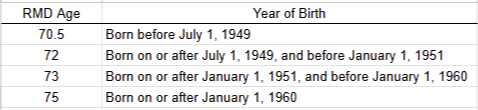
A Required Minimum Distribution, or RMD, is the minimum amount that must be distributed from certain tax-deferred retirement accounts each year once you reach the applicable RMD age. Your RMD age depends on your year of birth: 70½ for those born before July 1, 1949; 72 for those born on or after July 1, 1949, and before January 1, 1951; 73 for those born on or after January 1, 1951, and before January 1, 1960; and 75 for those born on or after January 1, 1960. Your first RMD is due by April 1 following your first distribution year, and later RMDs are generally due by December 31 of each year. Failing to take an RMD by the deadline may result in an excise tax on the amount not distributed.


What is the penalty for not taking my Required Minimum Distribution?

The penalty for missing an RMD is generally a 25% excise tax on the amount that should have been withdrawn. The penalty may be reduced to 10% if the missed RMD is corrected within the required time frame and the account owner files IRS Form 5329 with a request for waiver that explains the error and the steps taken to correct it.

What is the best way to save for college?

The best option depends on your role, such as student, parent, or guardian, and on your priorities, including tax benefits, investment risk, flexibility, and control.

  • 529: Best tax benefits for college, flexible plan choices; Tax-free growth for qualified education withdrawals; high contribution limits; some states offer state tax deductions/credits; 10% penalty on earnings if not used for qualified educational expenses.
  • Roth IRA: Flexible use, limited contribution, and retirement trade-off. (for parents or students with earned income): Contributions can be withdrawn tax- and penalty-free.
  • UGMA/UTMA: Flexible but less favorable for student aid and control. No education-only restrictions, contributions are a completed gift to the child and are in the child’s control once they attain legal age and may affect financial aid more than a 529. Taxes are complicated by “kiddie tax” rules.
  • Coverdell: OK for K–12 + college but low contribution limits and income phaseouts apply; must be distributed by the beneficiary’s 30 th birthday.
  • Prepaid: Lock in tuition at participating schools (state-specific)—useful when you have certainty about using an in-state public schools.

How much do I need to start a 529 plan?

Investment minimums vary by the 529 sponsor/custodian.

How much should I save for retirement?

The answer depends on how old you are now, when you plan to retire, how much your life is going to cost in retirement, and what other resources will be available to you in retirement. Knowing those variables and factoring in your life expectancy, your risk profile, and inflation, we can help you determine how much you should be saving now for a successful retirement.

When should I contact a financial advisor to talk about funding retirement?

Now.

Aging and Estate Planning

How do I prepare for getting older?

Start by getting organized. Work with your financial advisor, attorney, CPA, physician, and trusted family members or friends to develop an aging plan that addresses:

  • the quality of life you desire as you age,
  • where you want to age,
  • how you want to age,
  • how and where you want to receive care should you need it, and
  • how will you pay for that care and your normal medical needs and regular expenses?
  • who will have legal authority to help you while you are still living and can help you carryout your wishes when you are gone? Have you executed the necessary documents to grant that legal authority
  • who will take care of your pet(s) when you are gone?

Planning ahead helps you prepare for the final chapter of life and can leave your family a legacy of love instead of a legacy of decisions not made. Live well. Die well.

What documents do I need to give others authority to help me during my lifetime or carry out my final wishes at death?

Common estate planning documents include wills, trusts, advance healthcare directives, such as a living will, healthcare surrogate designation, and HIPAA authorization, and a durable power of attorney. The documents you need will depend on the complexity of your estate and where you live. In addition to legal documents, you may also want to include an ethical will or love letter. Depending on your medical status, you may also need a POLST, which stands for Physician Orders for Life-Sustaining Treatment, or a DNRO, which stands for Do Not Resuscitate Order.

What is a DNRO?

In Florida, a DNRO, or Do Not Resuscitate Order, is a one-page, easily identifiable form developed by the Florida Department of Health. It is intended to identify a patient whose healthcare provider has directed paramedics and emergency medical technicians not to resuscitate the patient in the event of respiratory or cardiac arrest. A DNRO is a specific and limited direction to paramedics and EMTs only. They are not required to review or interpret any other type of DNR direction, advance directive, or POLST document. A DNRO, and any copies of it, must be printed with a full-page yellow background or on yellow paper to be valid. Any shade of yellow is acceptable. 
(https://www.floridahealth.gov/about-us/resources/do-not-resuscitate-order/)

What is a POLST?

In Florida, a POLST, or Physician Orders for Life-Sustaining Treatment, is a portable, doctor-signed medical order that records a person’s wishes for care during serious illness or near the end of life. It is completed after a conversation between the doctor and patient about what treatment the patient does or does not want. Once signed, it guides care in settings such as ambulances, hospitals, and nursing facilities. (https://prepareforyourcare.org/en/prepare/faqs/polst)

Who should consider a POLST?

A POLST is generally intended for people who are very frail or seriously ill and want their treatment choices clearly followed. For example, a person with advanced cancer may decide that they do not want aggressive treatment if another serious condition occurs. The goal is to make the person’s wishes clear before an emergency.

What information does a POLST include?

A POLST addresses important choices during a serious health crisis, such as:

  • Whether the patient wants CPR if the heart or breathing stops
  • Whether the patient wants a ventilator or other breathing support
  • Whether the patient prefers care at home, in a hospital, or another facility

These choices tell healthcare workers whether the patient wants all available life-prolonging measures or care focused mainly on comfort.

Does a POLST take the place of an advance directive?

No. The two documents serve different purposes.

  • An advance directive names a healthcare decision maker, sometimes called a healthcare agent, who can act if the patient cannot communicate. It may also state general wishes about life support, but it is not a medical order. Advance directives are useful for all adults.
  • A POLST does not name a decision maker. It is a doctor’s order based on the patient’s choices and tells medical professionals what treatment should or should not be given. It is usually for people who are seriously ill or medically fragile.

How is a POLST obtained?

A doctor prepares the POLST after speaking with the patient or, when appropriate, the patient’s healthcare agent. The form must follow the required format, be signed by the doctor, and be printed on brightly colored paper, often hot pink, so it is easy to find. 

Where should a POLST be kept?

The POLST should be kept where emergency responders can find it quickly. Many responders check common visible places, such as the refrigerator, during a 911 call. Family members and caregivers should also know where it is located.

Can a POLST be updated?

Yes. A POLST may be canceled or replaced if it no longer reflects the patient’s wishes. Because it is a doctor-signed medical order, the patient should not simply edit it. If the patient’s choices change, the patient or healthcare agent should speak with the doctor about completing a new form.

What is a love letter?

A love letter is not a legal document. It is a practical and personal letter that tells your family what you own, where important items are kept, and who your key advisors are, including your CPA, financial advisor, attorney, insurance agent, and other important contacts. It can also include your funeral wishes, usernames and passwords, important websites, and anything you want your family to know but may not have said during your lifetime. It is a living document and should be updated regularly.

At what age should my children have their own legal documents?

When they turn 18. At that age, your child is legally considered an adult. In an emergency, healthcare providers have an obligation to protect your child’s privacy, which means you may not be able to receive information or make decisions without the proper legal documents. If your child is a sports prodigy with an estate created by NIL, or Name, Image, and Likeness, income, a will may be less urgent but can still be useful. In those circumstances, more sophisticated planning may be appropriate. For most young adults, the essential documents to consider at age 18 are a durable power of attorney and advance healthcare directives, including a living will, healthcare surrogate designation, and HIPAA authorization.

Divorce Planning

I just got divorced. What are some things I need to do to protect myself financially?

Start by updating beneficiaries on life insurance, 401(k) or similar retirement accounts, IRAs, and other investment accounts. If your former spouse is supposed to remain the beneficiary under your Marital Settlement Agreement or Final Judgment, complete a new beneficiary form naming your former spouse and identifying the relationship as “former spouse.” This helps show that the designation is intentional and not an oversight. If you are supposed to remain the beneficiary on your former spouse’s life insurance or investment accounts, work with your former spouse to make sure those changes are properly completed.


If you are awarded a portion of your former spouse’s 401(k) or other retirement plan that requires a Qualified Domestic Relations Order, or QDRO, make sure the QDRO or similar order is filed with the plan as soon as possible after the divorce.


If you are receiving part of your former spouse’s IRA, complete and submit the required paperwork to the IRA custodian immediately after the final judgment. Many custodians require a copy of the final judgment and Marital Settlement Agreement and may only honor them if they are dated within a certain period, such as 30, 60, or 90 days. Each custodian has its own requirements. Be sure the IRA is clearly identified in the agreement or judgment, such as “Fidelity IRA #1234.” If the account is not identified properly, or if the paperwork is outside the custodian’s deadline, the custodian may reject the request and you may have to return to court to have the documents refiled with a current date.


Once the divorce is final, a former spouse’s health insurance coverage is generally terminated. If you plan to continue coverage under your former spouse’s health insurance through COBRA, apply immediately. Although you may have 60 days to choose to elect coverage, premiums may still be due for that period. If you have health insurance through your own employer but were covered under your former spouse’s plan, apply for coverage under your group health plan within 30 days of the qualifying event, which is usually the date of the Final Judgment, so you can enter the plan outside the normal enrollment period.


If your former spouse is covered under your health insurance, notify your employer immediately once the divorce is final so they can provide the required COBRA notices to your former spouse.


Review all of your insurance coverage, including home, auto, umbrella, and other policies. As a single person, your needs may have changed, and you may lose multi-car, multi-line, or other discounts that can affect your premiums.


Execute new legal documents. Common estate planning documents include wills, trusts, advance healthcare directives, such as a living will, healthcare surrogate designation, and HIPAA authorization, and a durable power of attorney. The documents you need will depend on the complexity of your estate and where you live. You may also want to include an ethical will or love letter. Depending on your medical status, you may need a POLST or DNRO. Finally, review your entire financial plan. As a single person, your priorities, goals, and needs may have changed, and your plan should reflect your current life.


Breathe. There is life after divorce.